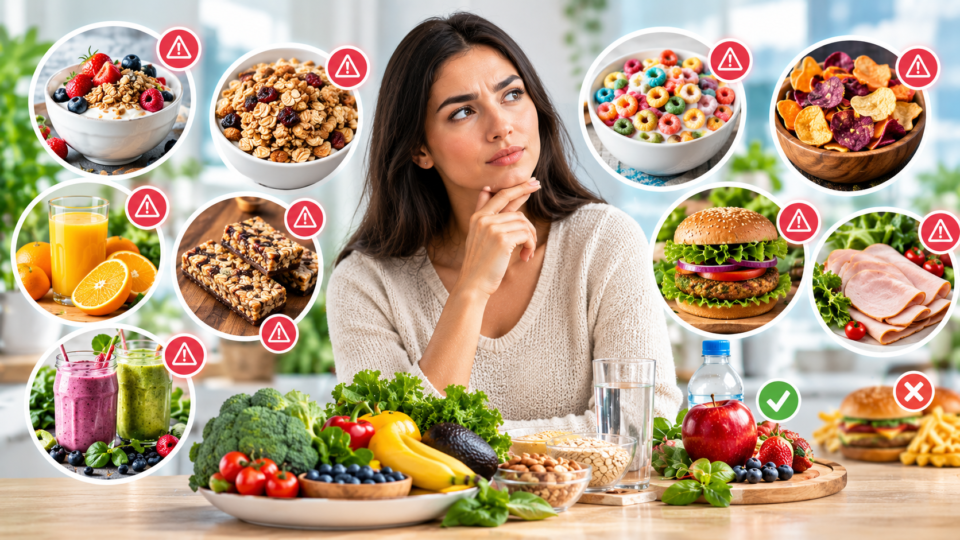
Walking through a supermarket today can feel like navigating a maze of “healthy” choices. Packages promise natural ingredients, high protein, whole grains, low fat, organic, plant-based, or no added preservatives. Yogurt is covered with pictures of fresh berries. Granola is surrounded by images of oats and nuts. Protein bars promise energy and fitness. Fruit juice appears to offer all the goodness of fruit in a convenient bottle.
But there is a problem with many of these products: looking healthy and actually being healthy are not always the same thing.
Some foods have what nutrition experts sometimes call a “health halo.” Their packaging, ingredients, or reputation can make us believe they are healthier than they really are. That does not mean these foods are automatically unhealthy or should never be eaten. Instead, the issue is often what has been added, how much we consume, how frequently we eat them, and what they replace in our diet.
A flavored yogurt can provide protein and calcium but also contain considerable added sugar. A smoothie can contain fruit and vegetables yet deliver hundreds of calories when combined with sweetened yogurt, juice, nut butter, and syrups. A plant-based burger may contain less saturated fat than a beef burger but still be highly processed and relatively high in sodium.
Here are 10 seemingly healthy foods that deserve a closer look.
1. Flavored Yogurt
Yogurt has a legitimate reputation as a nutritious food. It can provide protein, calcium, and, depending on the product, live cultures that support the gut microbiome.
The problem begins when yogurt becomes more dessert-like than dairy-like.
Many flavored yogurts contain added sugars to make them sweeter and more appealing. Fruit-flavored varieties may contain relatively little actual fruit while relying on sugar, fruit preparations, syrups, or other sweeteners for flavor.
The result can be a product that sounds healthy because the front of the package features strawberries, blueberries, or peaches, while the nutrition label tells a different story.
The better approach is not to abandon yogurt. Choose plain Greek yogurt or another unsweetened variety and add fresh berries, chopped fruit, nuts, or seeds yourself. This gives you greater control over sweetness while adding fiber and other nutrients.
Also remember that “low-fat” does not automatically mean “healthier.” A reduced-fat yogurt can still contain substantial added sugar.
2. Granola
Granola may be one of the ultimate health-halo foods.
Oats, nuts, seeds, dried fruit, and whole grains can all be nutritious ingredients. The problem is that many commercial granolas combine these ingredients with significant amounts of added sugar, honey, syrups, oils, or other calorie-dense ingredients.
Because granola is dry and concentrated, a relatively small serving can contain a surprising number of calories. The serving size printed on the package may also be considerably smaller than the amount people actually pour into a bowl.
A “healthy” breakfast can therefore become a large calorie load when a generous serving of granola is combined with sweetened yogurt, dried fruit, and honey.
You do not have to eliminate granola. Instead, measure the portion and look for products with whole grains, nuts, and seeds but relatively little added sugar.
You can also make your own using oats, nuts, seeds, cinnamon, and a modest amount of sweetener.
3. Fruit Juice
Fruit is one of the healthiest foods you can eat. That sometimes leads people to assume that drinking fruit juice is essentially the same as eating whole fruit.
It is not.
When fruit is turned into juice, much of the physical structure and fiber of the whole fruit is lost. Even 100% fruit juice can contain a substantial concentration of naturally occurring sugars, making it easy to consume the equivalent of several pieces of fruit in a short period of time.
WHO classifies sugars naturally present in fruit juice as free sugars and recommends limiting free-sugar intake. The organization also emphasizes choosing whole fruits and vegetables as important sources of dietary fiber.
Juice can certainly contain vitamins and other beneficial compounds, but it is much easier to overconsume than whole fruit.
An orange takes time to peel, chew, and eat. Drinking several oranges’ worth of juice can take less than a minute.
For most people, water and whole fruit are better everyday choices. If you enjoy juice, keep portions modest and treat it as part of your overall diet rather than as unlimited “health food.”
4. Protein Bars
“High protein” has become one of the most powerful marketing messages in modern nutrition.
Protein is essential for maintaining muscle, supporting tissue repair, and promoting satiety. But the words protein bar do not automatically mean healthy snack.
Some protein bars are essentially candy bars with extra protein.
They can contain large amounts of added sugar, sugar alcohols, saturated fat, or highly refined ingredients. Some are also surprisingly calorie-dense, particularly when they contain chocolate coatings, nut butters, caramel, or other additions.
The most important question is not simply how much protein a bar contains. Look at the complete nutrition label.
Check protein, fiber, added sugar, saturated fat, sodium, calories, and serving size.
A good protein bar can be useful when you are traveling, exercising, or need a convenient snack. But if you are eating several every day simply because the package says “fitness” or “high protein,” it may be worth reconsidering.
For many people, whole foods such as Greek yogurt, eggs, nuts, fruit, cottage cheese, or beans can provide protein without relying heavily on processed snack products.
5. Smoothies
Smoothies can be extremely nutritious—or they can quietly become liquid desserts.
A homemade smoothie made from whole fruit, vegetables, plain yogurt, and water can be a convenient way to consume nutritious foods. Because the whole fruit is blended, much of its fiber remains.
The problem occurs when smoothies become overloaded with ingredients.
A single drink might contain bananas, mango, berries, fruit juice, sweetened yogurt, honey, dates, nut butter, protein powder, and granola. Individually, many of these foods can be nutritious. Combined in large quantities, however, the smoothie can become very high in calories and sugar.
Commercial smoothies can be particularly difficult because you may not know exactly how much of each ingredient is being used.
If you make smoothies at home, prioritize vegetables and whole fruit, use unsweetened yogurt or milk, and avoid automatically adding juice or sweeteners.
And remember: chewing whole fruit generally makes it easier to recognize how much you are eating.
6. “Healthy” Breakfast Cereals
Breakfast cereal can be an excellent source of whole grains and fiber—or a bowl of highly processed carbohydrates with a surprisingly high sugar content.
The words “whole grain,” “multigrain,” “fortified,” and “contains vitamins” can make cereal appear extremely nutritious.
But fortified vitamins do not necessarily compensate for excessive added sugar, low fiber, or oversized portions.
Some cereals contain whole grains but also substantial amounts of added sugar. Others may use refined grains while emphasizing small amounts of vitamins or minerals added during processing.
When choosing cereal, look beyond the front of the box.
Check whether a whole grain appears as the first ingredient. Look at fiber, added sugar, sodium, and serving size. Remember that the amount you actually pour into your bowl may be significantly larger than the labeled serving.
Plain oats, unsweetened whole-grain cereals, shredded whole grains, or low-sugar muesli can be simpler choices.
You can then add fresh fruit, nuts, seeds, or plain yogurt for additional nutrition.
7. “Healthy” Snack Packs
The snack aisle contains countless products marketed as better alternatives: veggie chips, baked chips, rice cakes, flavored nuts, fruit snacks, energy bites, and “natural” crackers.
Some can fit into a healthy diet. The problem is assuming that words such as baked, natural, organic, or vegetable automatically make a product nutritious.
A vegetable chip may still be a highly processed snack containing refined starch, oil, and salt. A fruit snack may contain little resemblance to whole fruit. A small package of flavored nuts may contain added sugar or substantial sodium.
The important distinction is between the healthfulness of an ingredient and the nutritional quality of the final product.
Instead of asking, “Does this snack contain something healthy?” ask, “What is this food mostly made of?”
A snack based on whole nuts, fresh fruit, vegetables, hummus, plain yogurt, or roasted chickpeas can provide substantially more nutritional value than a highly processed snack carrying a healthy-sounding label.
8. Plant-Based Meat Alternatives
Plant-based burgers, sausages, nuggets, and other meat alternatives can be useful foods, particularly for people trying to reduce their consumption of red or processed meat.
But “plant-based” does not automatically mean “minimally processed.”
Some meat alternatives are made from concentrated or isolated plant proteins and can contain significant amounts of sodium and other additives. Their nutritional profiles vary considerably between products.
This is why comparing the nutrition label is important.
A plant-based burger may contain less saturated fat than a beef burger while still being relatively high in sodium. Another product may provide a useful amount of protein and fiber with a more favorable nutritional profile.
There is also a difference between a highly processed meat substitute and naturally plant-based foods such as lentils, beans, chickpeas, tofu, nuts, and whole grains.
If you enjoy meat alternatives, they can be part of a balanced diet. But do not assume that the word “plant-based” makes every product automatically healthy.
9. Dried Fruit and Fruit-Based Snacks
Dried fruit is not inherently bad. Raisins, dates, apricots, figs, and other dried fruits can provide fiber, minerals, and naturally occurring plant compounds.
The problem is concentration.
Removing water makes fruit much smaller, which means you can eat a large amount of fruit sugars and calories without feeling as full as you would after eating the equivalent amount of fresh fruit.
Some commercial dried-fruit products also contain added sugar.
A handful of raisins can be eaten quickly. Eating several whole grapes or an apple usually takes longer and provides more physical volume.
Dried fruit can therefore be useful in controlled portions, particularly when combined with nuts or seeds, but it should not automatically be treated as an unlimited healthy snack.
Check the ingredient list and choose products without unnecessary added sugars when possible.
10. Processed “Healthy” Meat Products
Turkey slices, chicken sausages, reduced-fat deli meats, and other products marketed as lean or healthier alternatives may appear to be smart choices.
But “low fat” does not necessarily mean “low sodium,” and a lean processed meat is still a processed meat.
Processed meats are commonly preserved through salting, curing, fermentation, smoking, or similar methods. Many products can contain substantial sodium, and some contain preservatives and other additives.
WHO and other health organizations recommend limiting processed meat consumption.
If you want a convenient protein source, consider rotating processed meat products with less processed options such as fresh poultry, fish, eggs, beans, lentils, chickpeas, tofu, or other minimally processed protein sources.
The goal does not need to be perfection. It is about changing the balance of your diet over time.
The Biggest Problem: The “Health Halo”
Why do these foods cause so much confusion?
Because food marketing often highlights one positive characteristic while leaving out the bigger picture.
A cereal may say “whole grain” while containing substantial added sugar.
A yogurt may say “high protein” while also being heavily sweetened.
A granola may contain oats and nuts but still be calorie-dense.
A protein bar may contain 20 grams of protein but also a long list of highly processed ingredients.
A smoothie may contain several servings of fruit but also hundreds of calories.
This is why looking at the entire nutrition label is more useful than judging a food based on one claim.
How to Read a “Healthy” Food Label
The next time a package claims to be healthy, take 30 seconds to look beyond the front.
Start with the serving size. Ask yourself whether you would realistically eat that amount.
Then check added sugars. In the United States, the Daily Value for added sugars is 50 grams on a 2,000-calorie diet, and the FDA recommends using the label to distinguish added sugars from naturally occurring sugars.
Next, look at fiber. Foods containing more fiber are often more filling and can support digestive and metabolic health.
Then check sodium and saturated fat, particularly in processed foods and savory snacks.
Finally, read the ingredient list.
The shorter the ingredient list is not automatically better, but recognizable whole-food ingredients can provide useful clues about how heavily a product has been formulated.
Are These Foods Actually “Bad”?
Not necessarily.
That is the most important point.
A flavored yogurt is not automatically unhealthy. Granola can be nutritious. Fruit juice can contain valuable nutrients. Protein bars can be convenient. Smoothies can be excellent. Plant-based meat alternatives can help people reduce their intake of red meat.
The problem occurs when these foods are consumed under the assumption that they are automatically healthier than their nutritional profiles suggest.
Health is determined by your overall dietary pattern—not by whether you occasionally eat one granola bar or drink a glass of juice.
A healthy diet can include packaged foods. The goal is to make minimally processed foods such as vegetables, fruits, legumes, whole grains, nuts, seeds, and appropriate protein sources the foundation, while paying attention to foods that are high in added sugars, sodium, unhealthy fats, or calories.
The Bottom Line
Some of the foods marketed as healthy really are nutritious—but others can become surprisingly unhealthy depending on their ingredients and portion sizes.
Flavored yogurt can hide added sugar. Granola can be calorie-dense. Fruit juice can deliver concentrated free sugars without the fullness of whole fruit. Protein bars can resemble candy bars with extra protein. Smoothies can become calorie-heavy when overloaded with sweet ingredients. Breakfast cereals can contain substantial sugar despite whole-grain claims. “Healthy” snacks can still be highly processed and salty. Plant-based meat alternatives vary widely in their nutritional quality, while processed lean meats can still deliver significant sodium.
The solution is not to become afraid of food labels or eliminate every packaged product.
Instead, learn to look past the health claims.
The healthiest-looking food is not always the healthiest choice—and the best food is often the one whose entire nutrition profile supports your needs, not simply the one with the most impressive words on the front of the package.
Sources
- World Health Organization (WHO) — Healthy Diet
Guidance on dietary diversity, minimally processed foods, free sugars, sodium, fruits and vegetables, whole grains, and healthy dietary patterns. - U.S. Food and Drug Administration (FDA) — Added Sugars on the Nutrition Facts Label
Explanation of total versus added sugars and the 50 g Daily Value used on U.S. Nutrition Facts labels. - Harvard T.H. Chan School of Public Health — Added Sugar
Information about hidden added sugars in yogurt, breakfast cereals, cereal bars, and other foods marketed as healthy. - Harvard T.H. Chan School of Public Health — Common Questions About Fruits and Vegetables
Discussion of whole fruit versus smoothies and juice, fiber, satiety, and calorie intake. - Harvard Health — Choosing a Healthy Breakfast Cereal
Guidance on whole grains, fiber, sugar, sodium, calories, serving sizes, and reading cereal labels. - Harvard T.H. Chan School of Public Health — Plant-Based Meat Alternatives
Discussion of processing, protein isolates, sodium, and differences between plant-based meat alternatives and minimally processed plant foods. - Harvard Health — Fresh Juice and Smoothies
Information about juice, smoothies, calories, fiber, added sweeteners, and portion control. - Harvard T.H. Chan School of Public Health — Food Label Guide
Guidance on interpreting added sugars, ingredient lists, and Nutrition Facts labels. - Harvard T.H. Chan School of Public Health — Processed Foods and Health
Overview of processed and ultra-processed foods and the importance of emphasizing minimally processed foods. - World Health Organization / IARC — Processed Meat and Cancer
Definition of processed meat and evidence underlying WHO/IARC recommendations concerning processed meat consumption. - American Heart Association — Plant-Forward Eating
Information on reducing meat intake, processed meats, sodium, saturated fat, and incorporating plant-based protein sources. - WHO Eastern Mediterranean Region — Healthy Eating and Nutrition
Regional guidance on limiting free sugars, salt, processed meats, and emphasizing fruits, vegetables, whole grains, and healthier fats.