

Medicines are powerful tools — they relieve pain, control infections, manage chronic conditions and save lives. But the same medicines that help us can also harm us when used incorrectly. The first line of defense against medication errors is right in your hands: the medicine label. Reading and understanding the label on prescription and over-the-counter (OTC) medicines helps ensure drugs are taken safely and effectively. This article explains what’s on medicine labels, why each section matters, common pitfalls, and practical tips for patients and caregivers.
Why medicine labels matter
Medicine labels are legally required communication tools designed to deliver essential, actionable information to patients and caregivers. They tell you what the medicine is, how much to take, when and how to take it, and what to avoid while using it. Clear labels reduce the risk of under- or overdosing, dangerous drug interactions, allergic reactions, and improper storage that can degrade a medicine’s effectiveness. For OTC products the FDA requires a standardized “Drug Facts” panel so consumers can compare products and follow instructions correctly. For prescription medicines, approved patient labeling and highlights of prescribing information summarize the most important safety and dosing details.
Key sections on a medicine label (and what they mean)
Understanding the common parts of a label makes it easier to follow instructions correctly.
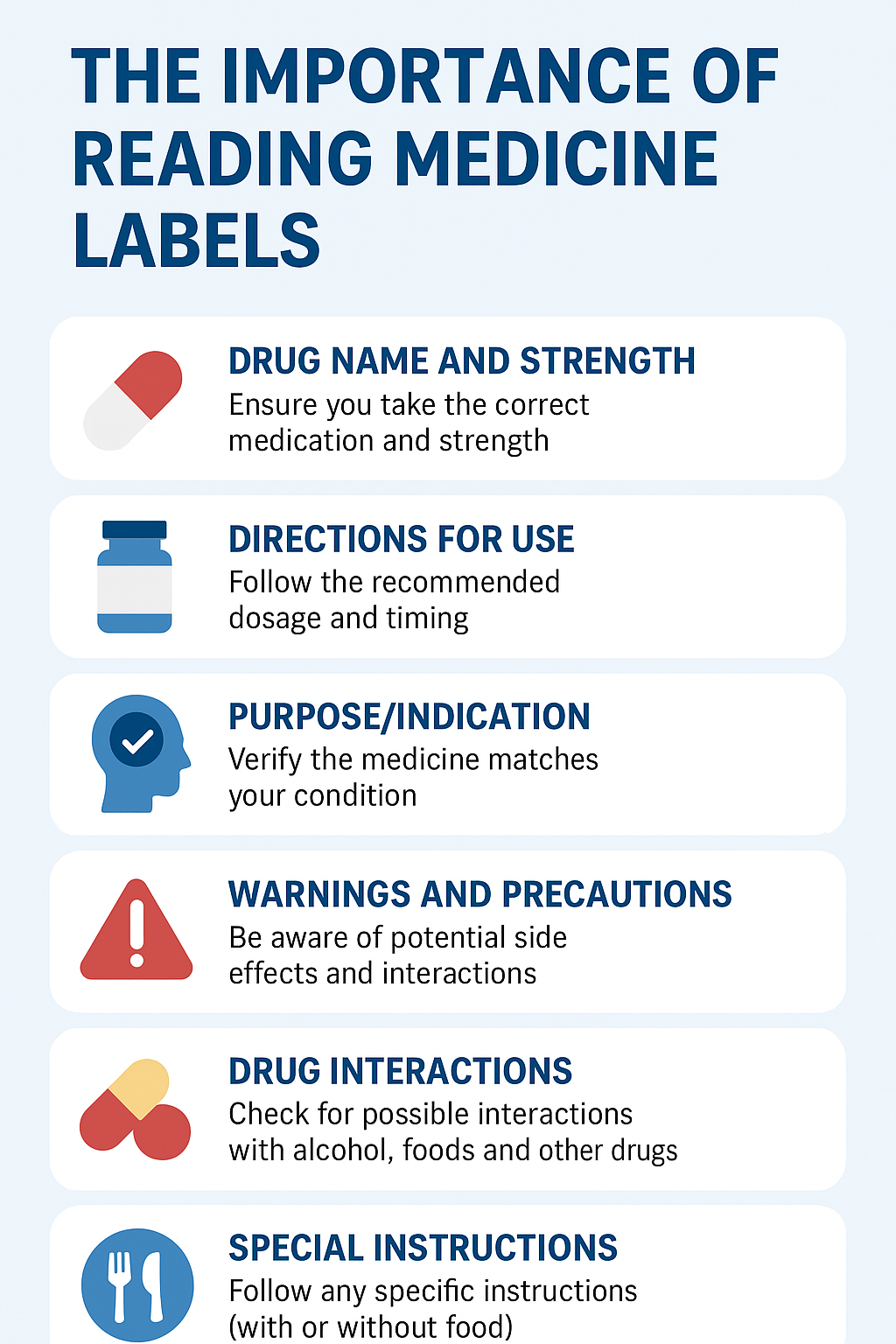
1. Drug name and strength
The label lists the brand and/or generic name and the strength (for example, “ibuprofen 200 mg” or “metformin 500 mg”). This ensures you take the correct medication and strength, especially important if you receive multiple prescriptions or use generics.
2. Directions for use (dosage and timing)
This tells you how much to take, how often, and for how long (e.g., “Take 1 tablet by mouth every 8 hours as needed; do not exceed 6 tablets in 24 hours”). Follow these instructions closely — small deviations can lead to lack of effect or toxicity. For liquid medicines, use the provided measuring device (not kitchen spoons).
3. Purpose / Indication
Some labels state what the medicine is for (e.g., “for fever” or “for type 2 diabetes”). This helps confirm the medicine matches your condition or the prescriber’s order. If it doesn’t, check with your pharmacist or prescriber.
4. Warnings and precautions
This section highlights major safety issues: allergies, activities to avoid (like driving if a drug causes drowsiness), and conditions where the drug shouldn’t be used (contraindications). Prescription labels may also include boxed warnings for very serious risks. Read warnings carefully and follow any special monitoring or avoidance instructions.
5. Drug interactions and other medicines to avoid
Labels often include warning statements to avoid combining the medicine with specific drugs, alcohol, or certain foods (e.g., grapefruit juice). Interactions can make a drug less effective or increase harmful side effects. If you take multiple prescriptions, OTC drugs, vitamins, or herbal supplements, check labels for interaction warnings and consult a pharmacist.
6. Special instructions (with or without food, how to take)
Some medicines must be taken with food to reduce stomach upset or to increase absorption; others must be taken on an empty stomach. Some tablets must not be crushed; others are designed to dissolve slowly and must be swallowed whole. Follow the specific instructions.
7. Storage, expiry and disposal
Labels state how to store the medicine (room temperature, refrigerated, protected from light) and the expiration date. Improper storage can reduce effectiveness or create safety risks. Discard expired medications safely.
Common label pitfalls and how to avoid them
Even clear labels can be misread. Here are frequent problems and practical fixes.
Ambiguous dose language — “Take as directed” is unhelpful if you don’t know the directions. Always look for the actual number and schedule, or ask your pharmacist to clarify.
Multiple prescribers or pharmacies — taking drugs prescribed by different doctors increases interaction risk. Keep an up-to-date medication list (include OTCs and supplements) and show it to each prescriber and pharmacist.
Using household spoons for liquids — kitchen spoons vary in volume and cause frequent dosing errors. Use the dosing cup, syringe, or spoon that comes with the medicine.
Assuming “more is better” — taking extra doses for faster relief can cause toxicity. Adhere to maximum daily dose instructions.
Language and literacy barriers — labels can be confusing for people with limited English or low health literacy. Ask for translated labels, pictograms, or a pharmacist’s counseling. Many pharmacies and health systems offer bilingual labels and simplified instructions.
Special populations: children, older adults, pregnant people
Children: Dosing is often weight-based; adult tablet dosages are not interchangeable with pediatric doses. Always use pediatric formulations and measuring devices. For infants and young children, double-check dosing with your pediatrician or pharmacist.
Older adults: Age-related changes in kidney or liver function can affect how drugs behave. Older adults are also more likely to take multiple medications, increasing interaction and side-effect risks. Labels and pharmacist review are vital.
Pregnant or breastfeeding people: Some medicines are unsafe in pregnancy or lactation. If the label doesn’t clearly address pregnancy or breastfeeding, consult your prescriber or pharmacist before taking the medicine.
What to do if a label is unclear or missing crucial information
- Ask the pharmacist. Pharmacists are trained to translate labels into clear instructions and to check for interactions.
- Call the prescriber. If the dose or indication doesn’t match what you expected, verify the prescription.
- Use reputable online tools cautiously. Official resources like FDA, NHS, and professional medical centers provide reliable, up-to-date information, but they don’t replace personalized advice from your clinician.
Simple habits that improve label safety
- Keep medicines in their original containers with labels intact.
- Maintain a current medication list (drug name, dose, reason, prescribing clinician). Carry it to all appointments.
- Read the entire label every time — mistakes happen when we assume “I know this already.”
- Avoid mixing medications in unlabeled containers (pill boxes are useful but keep original containers for reference).
- Report side effects or confusing instructions to your pharmacist or clinician promptly.
The role of health systems, manufacturers and regulators
Regulators like the FDA and healthcare systems set standards for label content and format (for example, the standardized OTC “Drug Facts” panel) to improve readability and safety. Pharmacies increasingly use bilingual labels, pictograms, and patient counseling to bridge literacy gaps. Clinician-facing sections of prescription labels (full prescribing information) complement patient labels by detailing interactions, warnings, and clinical data. Continued efforts to simplify language and use icons improve patient comprehension and reduce errors.
Final takeaway
Reading medicine labels is a simple, high-impact habit that helps prevent medication errors, avoid dangerous interactions, and ensure treatments work as intended. Labels contain the key information you need — but they work best when combined with pharmacist counseling, an up-to-date medication list, and good communication with prescribers. Make reading the label a standard step before taking any medicine — your health depends on it.
Sources
- U.S. Food & Drug Administration — The Over-the-Counter Drug Facts Label. U.S. Food and Drug Administration
- U.S. Food & Drug Administration — How Do I Use Prescription Drug Labeling / Prescribing Information. U.S. Food and Drug Administration
- Cleveland Clinic — Prescription Medication Labels: Parts & How To Read. Cleveland Clinic
- National Center for Biotechnology Information (PMC) — Improving Prescription Drug Warnings to Promote Patient Understanding. PMC
- UK GOV / MHRA — Packaging, labelling and patient information leaflets (best practice guidance). GOV.UK

