
Introduction
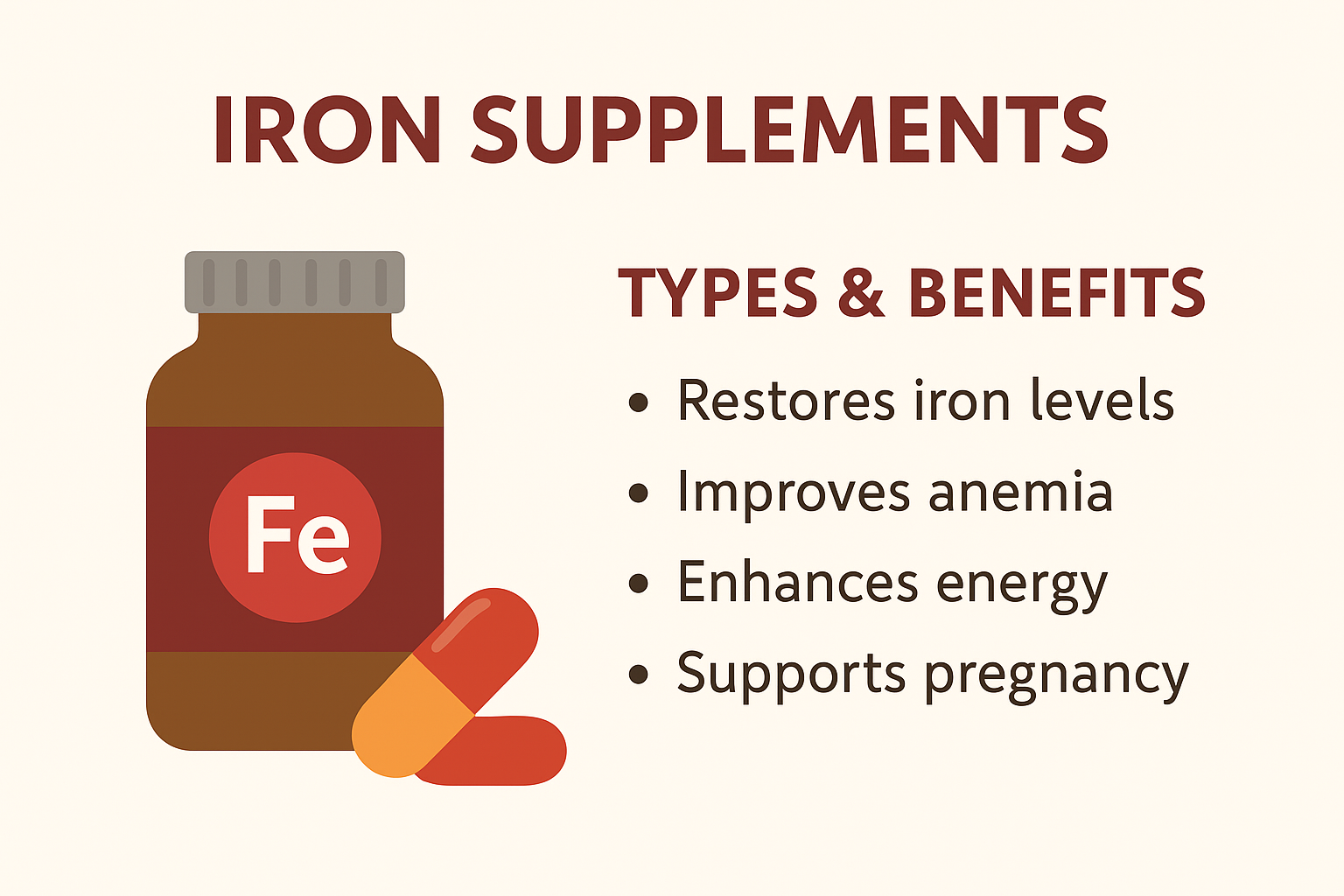
Iron is an essential mineral your body needs to make hemoglobin — the protein in red blood cells that carries oxygen — plus myoglobin for muscles and enzymes for energy and metabolism. When dietary iron or iron stores are low, people can develop iron deficiency and eventually iron-deficiency anemia, which commonly causes fatigue, weakness, poor concentration, and impaired immunity. This guide explains the main types of iron supplements (oral and parenteral), their benefits, how to take them for best absorption, common side effects, and who should (and shouldn’t) use them.
Who might need iron supplements?
People commonly recommended iron supplementation include:
- Women with heavy menstrual bleeding or pregnancy (increased iron needs).
- Infants, toddlers, and school-age children in high-anemia settings.
- People with proven iron-deficiency anemia (low hemoglobin and low ferritin).
- Individuals with malabsorption (e.g., after gastric bypass, celiac disease) or chronic blood loss (GI bleeding).
- Athletes with heavy training and low iron stores; strict vegetarians/vegans may also need monitoring.
Always confirm with a healthcare provider and blood tests (CBC and ferritin) before starting supplements. Unsupervised iron can cause harm if iron overload is present (e.g., hereditary hemochromatosis).
Main types of iron supplements
1. Oral ferrous salts (most common)
- Ferrous sulfate — widely used; typical tablet 325 mg provides ~65 mg elemental iron (formulations vary).
- Ferrous gluconate — lower elemental iron per tablet (often better tolerated).
- Ferrous fumarate — higher elemental iron per tablet (often 300 mg tablet ≈ 99 mg elemental iron in some formulations).
Ferrous salts (Fe²⁺) are generally better absorbed than ferric forms and are the first-line, cost-effective option for treating iron deficiency. Common tradeoffs: effectiveness vs. gastrointestinal (GI) side effects (nausea, constipation, abdominal pain).
2. Iron bisglycinate and other chelated forms
- Iron bisglycinate (ferrous bisglycinate) and other “chelated” forms bind iron to an amino acid (glycine) or similar carrier. These can be gentler on the stomach and may cause fewer GI side effects while offering good absorption in some studies. They’re often recommended for people who can’t tolerate ferrous salts.
3. Ferric formulations and newer oral complexes
- Ferric citrate, ferric sulfate, carbonyl iron, and heme-iron polypeptides are alternative oral formulations. Some are used for patients with specific needs (e.g., chronic kidney disease) or to attempt reduced side effects. Absorption varies by form.
4. Liquid iron
- Liquid formulations exist for infants, children, or adults with swallowing difficulty; concentration and elemental iron content vary. Careful dosing and safety (keep away from children) are essential since accidental overdose in children can be fatal.
5. Intravenous (IV) iron
IV iron is indicated when oral iron is ineffective, not tolerated, or too slow — for example, severe anemia needing rapid correction, ongoing blood loss, inflammatory bowel disease, chronic kidney disease, or when absorption is impaired. Modern IV irons include ferric carboxymaltose, iron sucrose, iron dextran (less commonly used today), ferumoxytol, and others. IV iron replenishes stores faster but requires medical administration and monitoring for rare allergic reactions.
Benefits of iron supplementation
- Restores hemoglobin and iron stores — The primary benefit is correcting iron deficiency and treating iron-deficiency anemia, improving oxygen delivery and symptoms like fatigue and breathlessness.
- Improves cognitive and physical performance — In children and adolescents, preventing iron deficiency supports learning and development; in adults, it can improve work capacity and exercise tolerance.
- Reduces maternal and fetal complications — In pregnancy, adequate iron lowers the risk of maternal anemia and some associated adverse outcomes.
- Faster recovery when oral therapy fails — IV iron can quickly replenish iron stores when oral therapy is insufficient or when rapid correction is required (e.g., before surgery or in severe anemia).
How to take oral iron for best absorption
- Timing: Take iron on an empty stomach if tolerated — typically 1 hour before or 2 hours after meals — because food (especially calcium, high-fiber foods) reduces absorption. However, if GI side effects occur, taking with a small meal is acceptable.
- Avoid inhibitors near dosing: Tea, coffee, milk, and calcium supplements reduce absorption; separate them from iron doses by at least 2 hours.
- Vitamin C: Traditionally recommended to take with vitamin C or a glass of orange juice to boost absorption, though newer trials show mixed results — Vitamin C can help but may not be essential for everyone. Discuss with your clinician.
- Dosing strategies: Traditional high-dose regimens (e.g., 65 mg elemental iron two or three times daily) are effective but often cause side effects. Lower daily doses or alternate-day dosing (e.g., every other day) are increasingly used to improve tolerance and absorption by reducing hepcidin-mediated blockade. Follow your provider’s plan based on lab results.
Side effects and safety
- Common side effects: Nausea, abdominal pain, constipation, diarrhea, and dark stools are the most frequent complaints with oral iron. These are dose-related and vary by formulation. Chelated forms may be gentler for some people.
- Serious risks: Accidental iron overdose is a medical emergency in young children — store supplements out of reach. People with iron overload disorders (e.g., hereditary hemochromatosis) should not take iron supplements unless supervised by a specialist. IV iron has rare risks of serious hypersensitivity or infusion reactions; it must be administered where reactions can be managed.
- Drug interactions: Antacids, proton pump inhibitors, levothyroxine, certain antibiotics, and calcium reduce iron absorption or interact; space dosing and consult your pharmacist.
Choosing a formulation — practical tips
- First try a ferrous salt (sulfate, fumarate, or gluconate) because they’re effective and inexpensive. If GI side effects are intolerable, consider switching to a lower-elemental-iron formulation (ferrous gluconate) or a chelated form (bisglycinate).
- If absorption is a concern (post-bariatric surgery, small-bowel disease), discuss IV iron with your provider.
- Pregnancy: Many clinicians recommend prenatal iron or targeted iron supplementation when indicated; follow prenatal care guidance and testing.
- Children: Use pediatric liquid iron when recommended, with dosing based on weight and close supervision to prevent accidental overdose.
How long to take iron
If treating iron-deficiency anemia, blood counts often begin to improve in 2–4 weeks, but iron stores (ferritin) may require 3–6 months (or longer) of continued supplementation after hemoglobin normalizes to replete reserves. Your clinician will advise when to stop based on follow-up labs.
Quick comparison table (oral options)
| Formulation | Elemental iron (typical) | Pros | Cons |
|---|---|---|---|
| Ferrous sulfate | ~20% (eg. 325 mg → ~65 mg) | Widely available, effective, low cost | GI side effects common |
| Ferrous fumarate | ~33% | Higher elemental iron per tablet | May cause GI effects |
| Ferrous gluconate | ~12% | Often better tolerated | More tablets needed for same elemental iron |
| Iron bisglycinate (chelate) | Variable | Gentler on stomach, good absorption | Usually higher cost |
| Liquid iron | Variable | For kids/people with swallowing issues | Taste, dosing variability; danger if accessed by children |
| IV iron | Depends on product | Rapid repletion, bypasses absorption issues | Requires clinic/infusion; rare serious reactions |
(Use this table as a rough guide — check specific product labels for exact elemental iron content and follow medical advice.)
Final takeaways
- Iron supplements are a safe, effective way to treat and prevent iron deficiency when used appropriately. NCBI
- Start with oral ferrous salts unless there’s a reason to use another form; consider chelated options if GI side effects limit tolerability. Haematologica
- Take iron strategically (timing, avoid inhibitors, consider vitamin C) to maximize absorption, and have iron status monitored by blood tests. MedlinePlus+1
- Don’t self-treat without labs and medical advice — both deficiency and overload carry risks. Office of Dietary Supplements+1
Sources
- National Institutes of Health — Office of Dietary Supplements: Iron — Health Professional Fact Sheet and Iron — Consumer Fact Sheet. Office of Dietary Supplements+1
- StatPearls / NCBI Bookshelf: Iron Supplementation overview (clinical guidance on oral and IV iron). NCBI
- World Health Organization (WHO): recommendations for daily iron supplementation in specific groups (children, women). World Health Organization+1
- MedlinePlus / U.S. National Library of Medicine: Taking iron supplements — dosing, absorption, and duration. MedlinePlus
- Cleveland Clinic: patient information on iron supplements and side effects. Cleveland Clinic
- Recent reviews and journal articles on oral iron formulations and newer approaches (e.g., bisglycinate, alternate-day dosing). Haematologica+1

1 comment
Great article! It provides a really comprehensive overview of iron supplementation. I especially appreciated the section comparing the different types of oral iron and their pros and cons. It got me thinking about a specific product.
You mention that ferrous gluconate is often better tolerated but requires more tablets to get the same amount of elemental iron. I was researching this and found a listing for a 300 mg ferrous gluconate coated tablet. I’m curious, for someone who needs a higher dose but has a sensitive stomach, could a single 300 mg ferrous gluconate tablet be a good compromise between effectiveness and tolerability compared to taking multiple lower-dose tablets? Does the coating significantly help with reducing GI side effects? Thanks for the insightful read!