
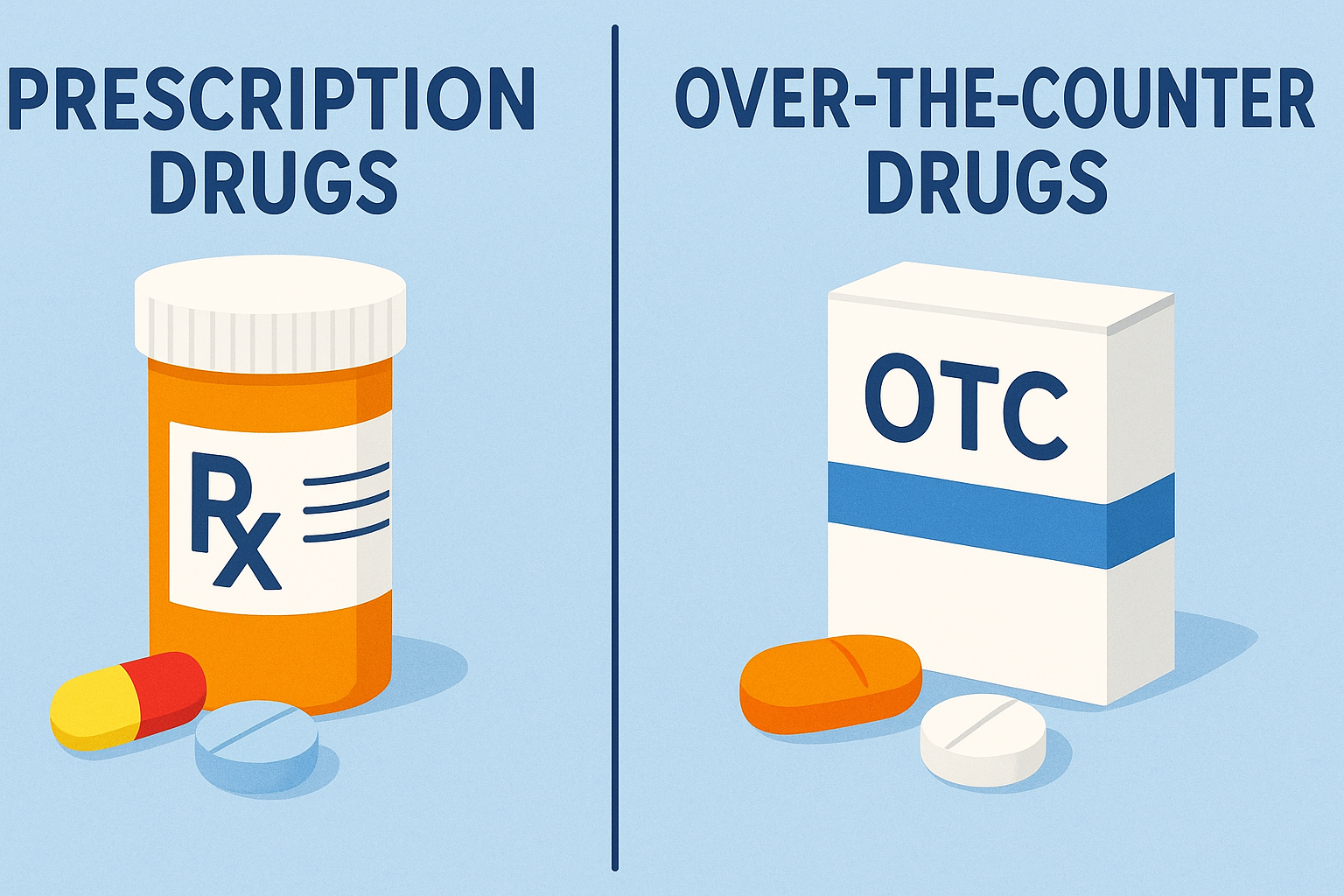
When you walk into a pharmacy or a supermarket and browse the aisles of medicines, you’ll see two broad categories: those you can purchase freely, and those you can only obtain with a prescription from a healthcare provider. Understanding the difference between prescription drugs and over-the-counter (OTC) drugs is critically important for safe and effective medication use. This article explains what sets them apart, how they are regulated, when each one is appropriate, and when you should seek professional advice.
What Are Prescription Drugs?
Prescription drugs are medications that require a prescription from a licensed healthcare provider (doctor, nurse-practitioner, physician assistant, etc.) before they can be dispensed. They are typically used for conditions that need professional diagnosis, monitoring, and dosing tailored to the individual.
Some of the key features of prescription drugs include:
- Require medical supervision: Because of their potency, complexity, risk of side-effects, or need for monitoring, they must be prescribed and monitored by a professional.
- Dispensed via pharmacies: Only licensed pharmacies (community, mail-order, hospital) can legally dispense them based on a valid prescription.
- Broad range of uses: They can address minor issues but also serious disease, chronic conditions, infections, mental health disorders, and more.
- Regulatory rigour: Before being approved, many prescription medications must undergo extensive clinical trials, safety monitoring, and risk-benefit evaluation.
- Tailored to the individual: The healthcare provider assesses the person’s condition, potential interactions with other medications or conditions, and prescribes the appropriate dose and form.
In short: these are medications that are powerful tools in medical care, but they also come with greater risks if misused or used without guidance.
What Are Over-the-Counter (OTC) Drugs?
Over-the-Counter drugs are medications you can buy without a specific prescription written by a healthcare provider. They are generally intended for conditions that are easier to self-diagnose and treat, and their safety profile allows them to be available directly to consumers.
Key features of OTC drugs include:
- No prescription needed: You can buy them in pharmacies, supermarkets, convenience stores in many places.
- Used for common, self-limiting conditions: For example, headaches, fever, minor aches and pains, mild allergies, heartburn, coughs.
- Label-directed usage: They come with standardized labels (“Drug Facts” in some jurisdictions) that detail active ingredients, uses, directions, warnings, and side-effects.
- Lower potency / broader safety margin: Because users are self-selecting and self-treating, regulatory authorities require that OTC drugs have larger margins of safety, fewer requirements for monitoring.
- Still carry risks: Just because they’re available without prescription doesn’t mean they’re risk-free. Interactions, misuse, overuse, and underlying health conditions can make OTC medications dangerous.
In other words: OTC drugs are more accessible and convenient, but they are intended for simpler situations, and responsible use is still important.
Comparing Key Differences
Here is a breakdown of the major differences between prescription and OTC medications:
| Characteristic | Prescription Drugs | OTC Drugs |
|---|---|---|
| Access | Requires a prescription from a licensed provider | No prescription needed; available directly for purchase |
| Need for diagnosis | Usually requires professional diagnosis & monitoring | Intended for conditions self-diagnosed by the individual |
| Strength / potency | Often stronger, more specialised | Usually lower strength with greater safety margin |
| Condition types | From minor to serious, chronic, complex diseases | Generally minor, self-limiting, easier to identify |
| Regulation & label | Many regulatory steps, monitoring, professional oversight | Regulated, but less intensive; must be safe for general use |
| Risk of misuse / interactions | Higher risk; misuse can cause serious harm | Still risk exists, but lower relative risk for the average user |
| Sharing/dispensing | Shouldn’t be shared; prescribed for a specific person | While easier to share, sharing still can be unsafe |
These differences are general; in some cases, the line can blur (for example when a medication moves from prescription to OTC status, or when a lower-strength OTC version exists alongside a higher-strength prescription version).
Why Does This Distinction Matter?
Understanding whether a medication requires a prescription or can be obtained OTC is not a mere administrative detail — it has real implications for safety, effectiveness, cost, ease of access, and risk. Some of the reasons this matters:
- Patient safety: Prescription drugs often require monitoring (for side-effects, drug levels, interaction with other medications, underlying health conditions). Without that supervision, misuse or adverse events are more likely. OTC drugs, while safer overall for general use, can still harm if misused, taken too long, or used inappropriately for a condition that needs professional care.
- Appropriate treatment: If someone self-treats a condition with only a mild OTC drug when in fact they needed a prescription medication and professional oversight, their condition may worsen or complications may occur. Conversely, using a prescription drug when an OTC would suffice may lead to unnecessary risks or costs.
- Cost and access: OTC drugs are often cheaper (no doctor visit required, no special prescription costs, easier access). Prescription drugs can be costlier due to professional fees, insurance considerations, pharmacy dispensing, and monitoring. This practical difference affects how people manage health care, especially in systems where cost is a barrier.
- Regulatory clarity: For regulatory agencies (e.g., Food and Drug Administration in the US) and for pharmacies, separating which drugs require professional oversight versus self-use is key to ensuring safe use across the population.
When to Use OTC Drugs — And When to Use Prescription
Appropriate Use of OTC Medications
OTC drugs are appropriate when:
- You have a mild condition that you can self-identify and that is unlikely to worsen or lead to serious complications (for example, occasional headache, mild allergy symptoms, mild heartburn).
- The labeling clearly indicates it is suitable for your age group, health status, and does not conflict with any conditions or medications you already have or are taking.
- The symptoms are familiar, short-term, and respond to previously known treatment.
- You are not using multiple medications without oversight; and you recognize when things may not be improving and need a doctor’s evaluation.
Indications for Prescription Medications
You should expect and plan to use prescription medications when:
- A healthcare provider diagnoses a condition that requires professional supervision, dosing adjustments, or monitoring (e.g., chronic disease management, infections requiring specific antibiotics, mental health conditions).
- The condition is serious, recurrent or complicated (for example persistent allergy not controlled by OTC, diseases like diabetes, high blood pressure, etc.).
- Previous OTC treatments have failed to relieve symptoms or condition worsens over time.
- You are taking other medications, have multiple health conditions, are pregnant, elderly, or have special considerations where choosing a safe medication requires professional input.
- The drug has a narrow therapeutic window, potential for significant side-effects, interactions, or misuse.
Key Safety Considerations & Practical Tips
Reading Labels & Understanding Ingredients
- For OTC drugs: Always read the “Active Ingredients”, “Uses”, “Warnings”, “Directions”, and “Other Information” sections of the label. The label provides valuable instructions on what you can safely treat.
- Be aware of generic vs brand names, and that some OTC drugs may have similar names or ingredients — you may inadvertently take two medications with the same active ingredient.
- Do not assume “over-the-counter” means “risk-free.” Conditions such as high blood pressure, kidney disease, liver disease, pregnancy, children, and the elderly require special caution.
Avoiding Interactions and Misuse
- Both OTC and prescription drugs can interact with other medications, supplements, foods, or alcohol. Always inform your healthcare provider or pharmacist about all medicines you take (prescription, OTC, herbal, supplements).
- Do not share prescription medications — they are tailored for one person’s condition and dose. Even OTC medications should not be shared if you are unsure of their suitability.
- Using higher doses than recommended, taking for longer than advised, or using prescription drugs without supervision can be very dangerous.
Recognising When to Seek Professional Advice
Even when you use OTC drugs, you should be alert for signs that indicate you need to consult a healthcare provider:
- The symptoms persist or get worse when using OTC medications.
- There is uncertainty about what condition you have, or you have not been diagnosed.
- You have underlying health conditions (e.g., heart disease, asthma, kidney/liver disease) or you are pregnant, older, or using many medications.
- You experience side-effects, new symptoms, or suspect a drug interaction.
- You are considering long-term use of what is intended for short-term relief.
The “Switch” from Prescription to OTC
An interesting aspect is that some drugs initially available only by prescription may later become available OTC. Regulatory authorities may determine that for a particular lower dose, formulation, or favorable safety profile, the medicine can be safely used without direct professional supervision.
Such “Rx-to-OTC” switches reflect evolving evidence, market need, and regulatory safeguards. But importantly, this doesn’t mean the higher-dose version or more complex uses become OTC; they may remain prescription only.
Summary & Take-Home Messages
- Prescription drugs and OTC drugs serve different roles: OTCs for more routine, self-managed conditions; prescriptions for more serious, complex, or risky situations.
- Accessibility is higher for OTC drugs, but that doesn’t eliminate risk. Responsibility and informed use still matter.
- Prescriptions require professional oversight, individual tailoring, and often monitoring.
- Always read labels, ask questions, declare all medications (OTC, prescription, supplements) to your healthcare provider, and recognise when you need professional help.
- If in doubt — when a condition is serious, persistent, uncertain, or when you have complicating health factors — consult a healthcare provider rather than relying solely on self-treatment.
When to Seek Professional Advice: A Quick Checklist
Consider seeing a healthcare provider if:
- You’re unsure about what is causing your symptoms.
- You have tried an OTC medication and you haven’t improved or you’ve gotten worse.
- You have multiple medical conditions, take several drugs, or are pregnant/elderly/child.
- You begin taking a new medication (prescription or OTC) and notice unusual side effects.
- You’re about to use a medication for a long term rather than short term relief.
- You’re planning to combine medications or have concerns about drug-interactions.
Final Thoughts
Medications are powerful tools in promoting health and relieving illness, but they are not without risk. The distinction between OTC and prescription drugs exists for very valid reasons: to protect safety, ensure appropriate use, and empower patients with the right degree of control. Using medicines responsibly — understanding what you are taking, how it works, what the risks are, and when you need professional help — is essential.
By being informed about the difference between prescription and OTC drugs, you are better equipped to make smart health-care decisions, use your medicines safely, and seek timely help when necessary.
Sources
- FDA. Prescription Drugs and Over-the-Counter (OTC) Drugs: Questions and Answers.
- GoodRx. OTC vs. Prescription Medications: 7 Key Differences.
- Baptist Health. Prescription vs. Over-the-Counter Medication.
- Horizon Health. OTCs vs. Prescription Meds – Knowing the Difference and When to Choose OTC.
- IWP Pharmacy. What is the Difference Between Over-the-Counter and Prescription?
- ConsumerMedSafety. Differences Between Prescription and OTC Medicines.
- MedlinePlus. Using Over-the-Counter Medicines Safely.
- MedlinePlus. Over-the-Counter Medicines.
- WebMD. Allergy Medicines: OTC vs. Prescription — What’s the Difference?
- IOPN (University of Illinois) Pressbook. Prescription Medication, Over-the-Counter Drugs, Dietary Supplements and Appearance & Performance Enhancers.

