
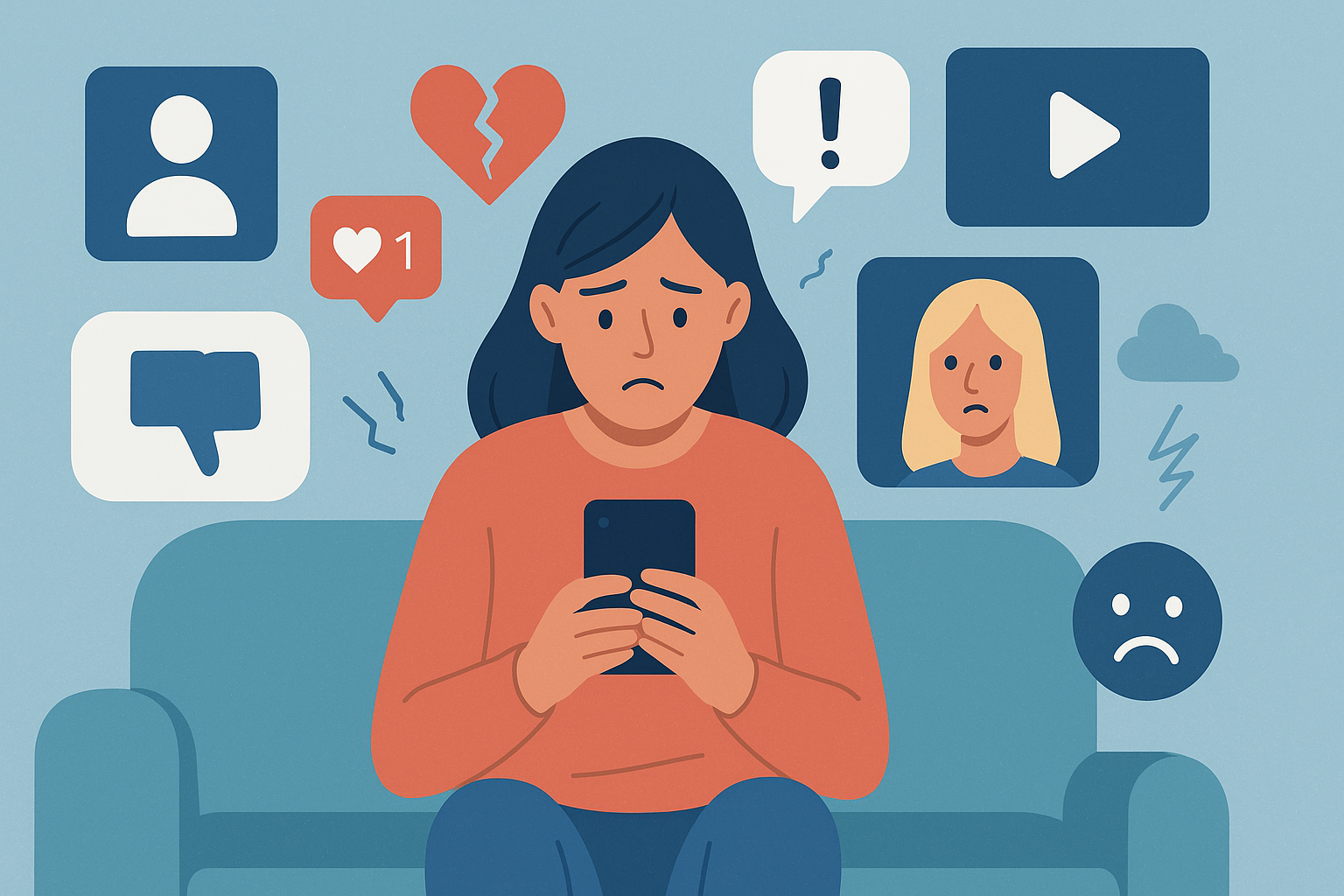
Social media is woven into daily life for billions of people. It shapes how we learn about the world, keep in touch, present ourselves, and spend our free time. That ubiquity raises an urgent question: how does the time we spend on Instagram, TikTok, YouTube, Snapchat, and other platforms affect our mental health? This article surveys current evidence and expert thinking to explain the main pathways (how effects happen), the mental-health outcomes most commonly linked to social media, who is most vulnerable, the limits of current research, and practical steps individuals, families, clinicians, and policymakers can take to reduce harm and maximize benefit.
What we mean by “social media” and why it matters
“Social media” refers to online platforms that enable creating, sharing, and responding to user-generated content, and that often use algorithms to recommend content people are likely to engage with. These platforms differ in format (short videos, images, long posts), audience (friends vs. public), and technical features (likes, follower counts, endless feeds), but they share two traits that matter for mental health: they make social comparison constant and effortless, and they are engineered to capture attention. Recent large surveys find that a large share of teenagers and young adults use social media daily and many describe its effects as mixed — both helpful for connection and harmful for wellbeing.
How social media can affect mental health — main pathways
Researchers have identified several overlapping mechanisms through which social media use can influence mental health:
• Upward social comparison and body-image pressure. Platforms that foreground curated photos and highlight reels make it easy to compare oneself to peers and influencers. Repeated exposure to idealized images can lower self-esteem and body satisfaction, particularly in adolescents and young women.
• Cyberbullying and social exclusion. Online harassment, shaming, or exclusion can be relentless because content is public, persistent, and easily amplified. Cyberbullying is linked to increased depression, anxiety, and suicidal thoughts among youth.
• Displacement of protective activities. Time spent scrolling can replace sleep, exercise, face-to-face relationships, and other activities that support mental health. Reduced sleep in particular is strongly associated with mood problems.
• Feedback loops and engagement-driven algorithms. Platforms use signals such as likes, comments, and viewing time to show more of what retains attention. This can reinforce anxiety-provoking or sensational content and contribute to compulsive checking and problematic use.
• Information overload and worry. Constant exposure to bad news, social conflict, or unrealistic expectations can increase stress and a sense of helplessness.
At the same time, social media can offer positive pathways: social support, peer connection (especially for marginalized groups), access to health information and communities, and opportunities for creative expression and identity exploration. The overall effect for any person depends on how the platform is used, what content they encounter, who they are, and what offline life it displaces.
What the evidence shows: associations—not simple cause-and-effect
A substantial body of research links heavier or problematic social media use with higher rates of depressive symptoms, anxiety, poor sleep, and lower self-esteem — particularly among adolescents and young adults. Systematic reviews report modest but consistent associations between frequent social media use and worse mental-health outcomes. However, the evidence rarely proves that social media causes mental illness in isolation; causality is complex and likely bidirectional (young people with emerging mental-health problems may spend more time online, and some online experiences may exacerbate problems). Researchers and expert panels emphasize that the relationship varies by individual and context.
Large recent population surveys and governmental advisories have raised concern because problematic use and negative self-reports of harm appear to be rising among teens. These trend data have helped push public-health agencies and professional bodies to produce guidance — not to demonize platforms, but to reduce risks and promote safer digital environments.
Specific effects: self-esteem, anxiety, depression, and relationships
Self-esteem and body image
Exposure to highly curated images and metrics of social approval (likes, follower counts) encourages comparison. For many users—especially adolescent girls—this can erode body satisfaction and confidence. Visual platforms that reward polished appearance intensify the pressure to meet narrow beauty norms; accounts promoting “ideal” lifestyles can create a persistent feeling of inadequacy.
Anxiety and stress
Social media can heighten anxiety through several channels: fear of missing out (FOMO), pressure to perform socially, endless notifications, and exposure to distressing content. The addictive design of platforms can create compulsive checking behaviors that maintain anxiety rather than relieve it.
Depression and mood
Multiple studies find correlations between heavy social media use and depressive symptoms. The effect size is typically small-to-moderate but meaningful at population level because so many young people use these platforms. The link is stronger when use is passive (scrolling and comparing) rather than active (messaging friends, creating content).
Sleep problems
Evening social-media use can delay sleep onset, fragment sleep, and reduce sleep quality — all of which are risk factors for mood disorders. Notifications, blue light, and emotional arousal from online interactions all contribute to sleep disruption.
Social relationships — mixed outcomes
Social media can strengthen ties with distant friends and provide belonging to niche communities (e.g., mental-health peer groups). Conversely, it can weaken close offline relationships if online interaction replaces face-to-face time or fosters superficial comparisons. For some young people it is a vital lifeline; for others, a source of social stress.
Who is most vulnerable?
Adolescents and young adults show the greatest risk for harm, largely because they are in sensitive developmental stages (identity formation, social reward sensitivity), often have irregular sleep, and are high-frequency users of social platforms. Within this group, girls and gender-diverse young people often report higher rates of appearance-related pressure and social anxiety. Individuals with preexisting mental-health conditions may also be more likely to experience negative effects and to use social media in ways that worsen symptoms.
Research limits and where uncertainty remains
There are important limitations to current evidence:
• Measurement inconsistency. Studies use widely varying definitions of “social media use” (time, platforms, active vs. passive) and “problematic” use, making comparisons difficult.
• Causal inference. Most studies are observational. Even longitudinal work struggles to rule out reverse causation and shared confounding factors (e.g., underlying vulnerabilities).
• Rapid platform change. Features, norms, and dominant platforms change quickly; research can lag behind the lived experience.
• Heterogeneity of experience. The same user can have helpful and harmful experiences depending on context, content, and social supports.
Recognizing these gaps, recent expert committees and public-health agencies have called for better-quality longitudinal and experimental studies, standardized measurement, and research that examines mechanisms and moderators (what makes harms more or less likely).
Practical recommendations (what individuals and families can do)
Even as research continues, several practical steps can reduce risk and support mental well-being:
- Prioritize sleep. Set a phone-free window before bedtime (e.g., 60 minutes) and turn off nonessential notifications at night. Good sleep is foundational to mental health.
- Use social media actively, not passively. Engaging directly with friends and creating content tends to be less harmful than endless passive scrolling and comparison.
- Curate your feeds. Unfollow accounts that trigger negative comparison, follow accounts that promote diversity and body positivity, and use platform tools to limit certain content.
- Set time and purpose limits. Consider app timers, scheduled “digital sabbaths,” or specific times for social-checking. Focused, purposeful use reduces displacement of protective activities.
- Promote media literacy. Teach young people that social media often shows curated highlights and edited images, not full reality.
- Talk about it. Parents and caregivers should have open, nonjudgmental conversations about online experiences; clinicians should assess social-media habits when evaluating adolescents.
- Seek help when needed. If social-media use is tied to worsening mood, self-harm thoughts, or daily dysfunction, professional support is important.
What policymakers and platforms can do
Public-health bodies and technology companies each have a role:
• Design for safety. Platforms can reduce addictive features (endless autoplay, misleading metrics), improve reporting/blocking tools, and limit exposure to harmful content for youth.
• Age-appropriate protections. Policies that verify age, restrict certain features for younger users, and enforce time-limits can help reduce risk.
• Research and transparency. Platforms should share anonymized data with independent researchers so the field can produce timely, high-quality evidence.
• Public education and access to care. Governments and schools should fund digital-literacy programs and mental-health services for young people.
WHO, national health agencies, and major professional bodies have issued guidance urging balanced public-health approaches that acknowledge benefits while reducing the risks—especially for children and adolescents.
Bottom line
Social media is neither inherently good nor evil for mental health. For many people it brings connection, identity, and information; for others it can fuel comparison, anxiety, sleep loss, and depression. The balance depends on how platforms are used, the content encountered, individual vulnerabilities, and what social media displaces in daily life. Current evidence points to modest but meaningful population-level associations between heavy or problematic use and worse mental-health outcomes — especially for adolescents — while also acknowledging important research gaps. Practical strategies at the individual, family, clinical, platform, and policy levels can reduce harms and amplify benefits while better evidence develops.
Sources
- Pew Research Center — Teens, Social Media and Mental Health (April 22, 2025). Pew Research Center
- World Health Organization (WHO) — Online lives, offline consequences and related policy brief on digital determinants of youth mental health (2024–2025). World Health Organization+1
- U.S. Department of Health and Human Services / Surgeon General — Social Media and Youth Mental Health advisory (2025). HHS.gov
- Systematic reviews: Khalaf et al., systematic review on social media and mental health (2023); Keles et al., systematic review (2020) — syntheses showing modest associations between social-media use and depression/anxiety in youth. PMC+1
- Ahmed et al., Social media use, mental health and sleep: A systematic review (2024) — evidence linking social-media use with sleep disturbance and downstream mood effects. ScienceDirect
- National Academies / Consensus and recent high-quality studies examining the complex links and calling for better evidence and measurement. PMC+1