
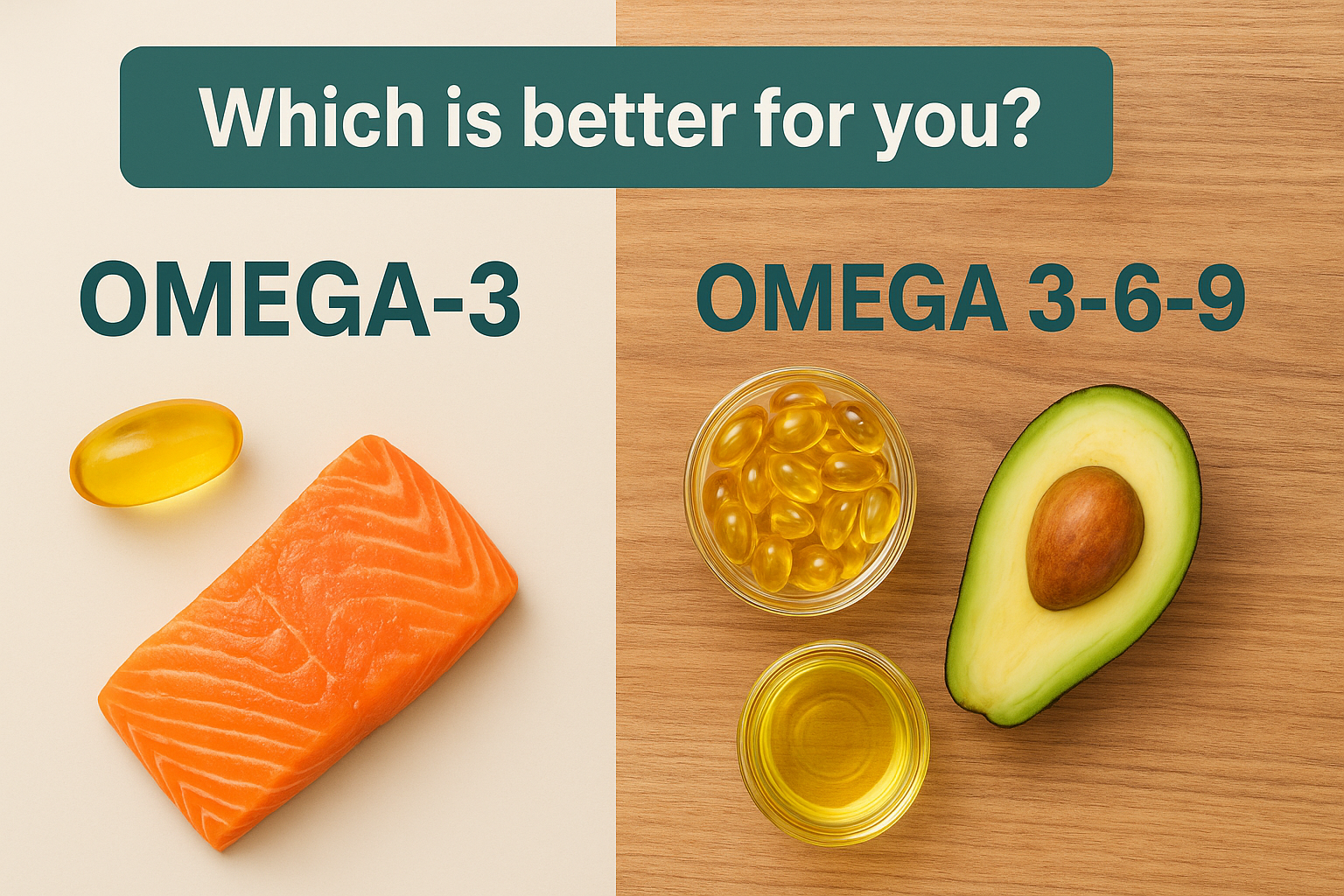
Fats are essential—your brain, heart and cells need them. But when it comes to supplements, the choices can be baffling: pure omega-3 (usually fish oil or algal oil) vs mixed omega 3-6-9 capsules (a blend of polyunsaturated and monounsaturated fats). Which is better for you? The short answer: for most people who don’t have unusual medical needs, focusing on getting omega-3 (EPA/DHA) from foods — or a targeted omega-3 supplement when appropriate — is the wiser choice. Mixed 3-6-9 supplements are rarely necessary for people eating a balanced diet. Below I’ll explain why, the science behind each fatty acid, how to choose, and practical tips.
Quick primer: what are omega-3, omega-6 and omega-9?
- Omega-3 fats include EPA and DHA (from fatty fish and algae) and ALA (from flax, chia, walnuts). EPA and DHA are the most biologically active forms for heart, brain and inflammation.
- Omega-6 fats (like linoleic acid, LA) are common in vegetable oils (soybean, corn, sunflower). They’re essential—your body can’t make them—but most people already eat a lot. Research increasingly suggests dietary omega-6 (LA) isn’t harmful at normal levels and may even reduce cardiovascular risk when it replaces saturated fat.
- Omega-9 fats (mainly oleic acid) are monounsaturated fats abundant in olive oil and nuts. They’re not essential (your body can make them), but they have proven benefits as part of a Mediterranean-style diet.
What “Omega 3-6-9” supplements actually are
3-6-9 supplements are commercial blends that combine:
- omega-3 (often small amounts of ALA and/or EPA/DHA),
- omega-6 (LA or other vegetable oils), and
- omega-9 (oleic acid from olive or canola oil).
They’re marketed as a convenient “all-in-one” oil. But the key question is whether adding extra omega-6 or omega-9 via supplements helps people who already get these fats in their diet — and whether the omega-3 dose in these blends is sufficient to produce health benefits.
Why many experts prefer targeted omega-3 (EPA/DHA) over 3-6-9 blends
- Most people already get plenty of omega-6 and omega-9 from food. Vegetable oils, nuts and olive oil supply large amounts of LA and oleic acid in typical Western and Mediterranean diets. Adding more via pills rarely fixes a deficiency.
- Health benefits are linked mainly to EPA and DHA. Strongest evidence for cardiovascular and anti-inflammatory effects centers on EPA and DHA (from fish or algal oils). Randomized trials and guideline statements focus on EPA/DHA doses, not on mixed 3-6-9 blends.
- Many 3-6-9 supplements contain low omega-3 doses. The omega-3 fraction in 3-6-9 capsules is often small compared with concentrated fish oil products; thus they may not deliver the clinically relevant EPA/DHA dose used in studies. If your goal is the omega-3 effect, a dedicated omega-3 product is usually more effective.
- Quality and purity matter. With any supplement, but especially omega oils, look for third-party testing (USP, NSF, ConsumerLab) to reduce risk of oxidation, contaminants or misleading labels.
Who benefits most from omega-3 (EPA/DHA) supplements?
- People with existing coronary heart disease or recent heart attack — guidelines advise about ≈1 g/day of EPA+DHA, preferably from oily fish; supplements can be considered under medical guidance.
- People with high triglycerides — higher prescription omega-3 doses (under physician supervision) can lower triglycerides.
- Pregnant or breastfeeding people — specific DHA recommendations support fetal brain and eye development (usually a few hundred mg/day).
- People who eat no or very little fatty fish — a supplement (or algal DHA for vegetarians) fills the gap.
For the general healthy adult who eats two servings of fatty fish per week, routine omega-3 supplementation is not strongly recommended by some authorities. Food first is usually preferred.
What about omega-6? Should you avoid it?
Omega-6 fatty acids—especially linoleic acid (LA)—were once suspected of promoting inflammation, but large recent analyses show higher dietary LA is associated with lower cardiovascular risk when it replaces saturated fat. The total balance between omega-6 and omega-3 matters less than overall dietary patterns and the absolute intakes of EPA/DHA. In short: don’t fear omega-6 from whole foods and common vegetable oils used in moderation.
And omega-9 (oleic acid)? The “Mediterranean” friend
Omega-9 monounsaturated fats—chiefly oleic acid in olive oil—are a hallmark of the Mediterranean diet, which reduces heart disease risk. Omega-9 isn’t essential (your body can make it), but olive oil and nuts provide a healthful pattern of fats that improve cholesterol and endothelial function. For most people, consuming olive oil and nuts is a better route than taking omega-9 pills.
Practical decision guide: choosing between omega-3 and omega 3-6-9
- If your goal is heart or brain benefits linked to EPA/DHA: choose a pure omega-3 (fish oil or algal oil) that provides a meaningful dose of EPA+DHA (check label). 1 g/day EPA+DHA is often the discussed threshold for secondary prevention; smaller daily amounts from food are still beneficial.
- If you eat little fish and want general “balancing” of fats: prioritize improving your diet—add fatty fish, walnuts, flax/chia, olive oil—and only use supplements if diet change isn’t possible. A 3-6-9 pill is unlikely to substitute for these whole-food changes.
- If you already consume a lot of vegetable oils or follow a Mediterranean diet: a 3-6-9 supplement adds little value and may provide only a token amount of omega-3. A targeted omega-3 supplement (or eating fish) is preferable.
- If you have high triglycerides or specific medical indications: talk to your clinician about prescription omega-3 products or higher therapeutic doses; do not self-prescribe high-dose over-the-counter oils.
- Quality checks: regardless of type, pick products with third-party testing, clear EPA/DHA labeling, and low levels of oxidation. For fish oil, consider molecularly distilled or purified products to reduce contaminants.

Safety and dosage — what to watch for
- Typical dietary advice: aim for at least 250–500 mg/day of combined EPA+DHA for general health (food first). People with certain conditions may need higher amounts under medical supervision.
- High doses (>3 g/day) can affect bleeding and have other side effects; don’t take large therapeutic doses without medical oversight.
- Check interactions: omega-3s can interact with blood thinners; discuss with your doctor if you’re on anticoagulants.
- Pregnancy: choose prenatal formulations or DHA sources recommended by your clinician.
Bottom line — which is better?
- For most people seeking measurable, research-backed benefits (especially for heart and brain), targeted omega-3 (EPA/DHA) — achieved through fatty fish twice weekly or a quality omega-3 supplement when needed — is the better choice.
- Omega 3-6-9 supplements are generally not necessary for people eating a balanced diet and often deliver too little EPA/DHA to be meaningful. They may provide convenience but not better outcomes.
- Prioritize whole-food sources (fatty fish, walnuts, flaxseed, olive oil) and consider supplements to fill specific gaps or meet clinical needs.
Quick FAQ
Q: Can I take both a 3-6-9 and a fish oil?
A: You can, but it’s usually redundant. If your aim is omega-3 benefits, focus on the fish oil (or a higher-EPA/DHA product). Too many oils increase total fat calories and may oxidize.
Q: Are plant omega-3s (ALA) enough?
A: ALA (flax, chia, walnuts) is healthful but converts inefficiently to EPA/DHA. Vegetarians/vegans may prefer algal DHA supplements for reliable EPA/DHA intake.
Q: Should everyone take omega-3 supplements?
A: No. If you eat fatty fish regularly, supplements may add little. People with specific medical conditions or low fish intake are the main beneficiaries.
How to choose a supplement (shopping checklist)
- Check EPA + DHA amount per serving (not just “omega-3 total”).
- Look for third-party testing (USP, NSF, ConsumerLab).
- Check the expiration date and smell (rancid/off smell indicates oxidation).
- Prefer triglyceride or re-esterified triglyceride forms for absorption if possible.
- For vegetarians, choose algal DHA/EPA formulas.
Final thought
Fats aren’t the enemy—the type and source matter. A diet centered on whole foods (fatty fish, olive oil, nuts, seeds, vegetables) gives you the best mix of omega-3, omega-6 and omega-9 for long-term health. If you use supplements, let your goals (heart disease prevention, triglyceride lowering, pregnancy) guide you: in most cases, choose a targeted omega-3 (EPA/DHA) supplement rather than a generic 3-6-9 pill.
Sources
- Office of Dietary Supplements (NIH). Omega-3 Fatty Acids — Health Professional Fact Sheet. ODS
- American Heart Association. Are you getting enough omega-3 fatty acids? (AHA coverage and recommendations). www.heart.org
- Harvard T.H. Chan School of Public Health — The Nutrition Source. Omega-3 fats. The Nutrition Source
- Siscovick D.S., et al. AHA scientific statements and reviews on omega-3 and cardiovascular disease. AHA Journals
- Recent systematic reviews and meta-analyses on omega-6 and omega-3 balance and health outcomes (PubMed / PMC). PMC+1
- Reviews on omega-9 (oleic acid) and the Mediterranean diet (Mayo Clinic / PubMed). PubMed+1


2 comments
Cool Post.
Cool Post.